Wednesday, August 17, 2016

Statistical Questions

What makes a question a statistical question? Furthermore, what makes a good statistical question?

The Common Core State Standards (6.SP.A.1) describes it like this:
... one that anticipates variability in the data related to the question and accounts for it in the answers. For example, “How old am I?” is not a statistical question, but “How old are the students in my school?” is a statistical question because one anticipates variability in students’ ages.
This statistics standard is slated for 6th grade students1, but I recently heard a more effective explanation of what a statistical question is that will be relevant for middle school, high school, and college statistics. It also defines what makes a statistical question a good one, which the Common Core definition does not.

Thursday, August 11, 2016

ASA's Prediction 2016 Contest


The American Statistical Association has a challenge for stats-savvy students: predict* the next U.S. president!

Prediction* 2016 is a contest for high school and undergraduate college students to predict* the winner of the U.S. presidential election using statistical methods. Winners will receive a variety of prizes and perks, including exposure to the nation’s leading statisticians and data scientists.

Friday, May 20, 2016

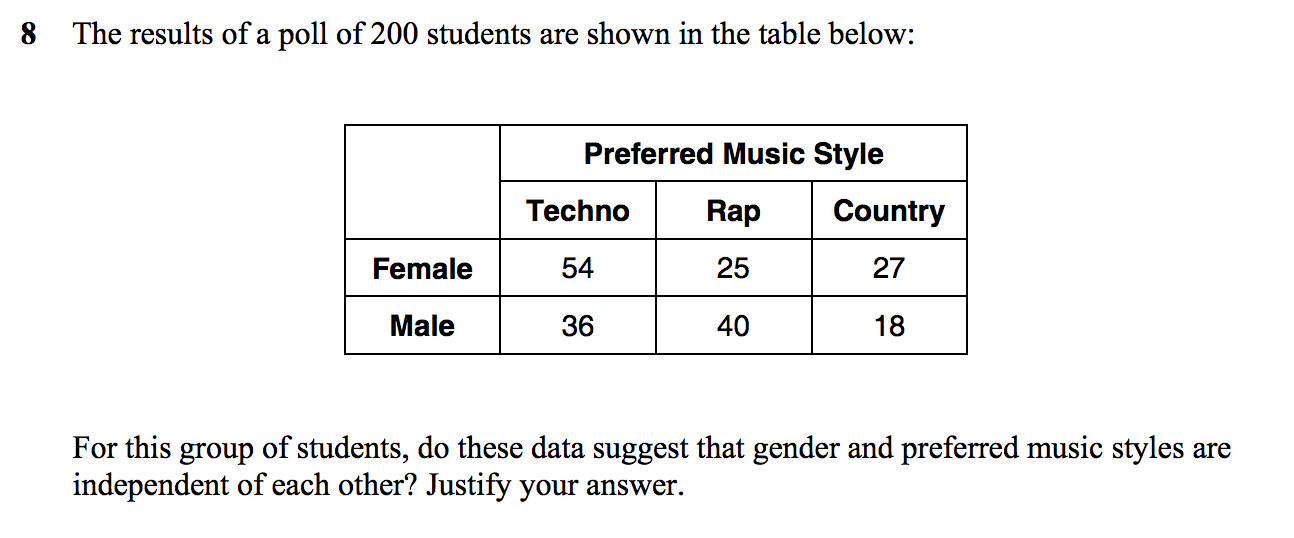
Common Core Algebra II: Music and Gender


In Fall 2015, NYS released a set of sample questions for the new Common Core Algebra II Regents. They included this question regarding independence. I've done similar questions like this with my AP Statistics students. Here, I outline how I would improve and present this question to Algebra II students. In fact, I've created two enhanced versions of this problem.

Sunday, May 1, 2016

The Wrong Way to Target Math (Part III)


I have waited over two months to continue my thoughts on Andrew Hacker. To be honest, the draft of this post has been sitting untouched since my first two posts. I thought the wait might help me mollify my response to his NY Times OpEd pieces and The Math Myth. Largely, though, it hasn't. I am still just as frustrated as I was before. Here, I'll try my best to wrap up my thoughts because I am eager to put him out of my mind soon. My goal is to answer questions like "Who Needs Statistics?" and "Is Political Science Necessary?" But first, in order for you to fully understand, I'll need to talk about knitting. No, really.

Monday, February 29, 2016

The Wrong Way to Target Math (Part II)

Andrew Hacker: Which graph wore it better? 

Now that we've summarized the Hacker philosophy of math education, let's get back to my issues with the most recent Andrew Hacker OpEd regarding his insults to AP Statistics. This is where I start to get angry.

Sunday, February 28, 2016

The Wrong Way to Target Math (Part I)


If you know me (or follow me on Twitter), you know I have a few choice words for people like Andrew Hacker, with his anti-math stance and negative opinions on math education. I wasn't going to write anything because I didn't want to lend credibility to him or his agenda, but I can't contain myself any longer. He's really pissed me off with his most recent NY Times OpEd "The Wrong Way to Teach Math" by taking aim directly at AP Statistics. Don't worry, I promise I did not use profane language.  I used as little profane language as I could.

Sunday, September 27, 2015

Putting Stats Projects into Practice

Over the years, one of the ways that I've grown as a stats educator is to incorporate more projects and activities into my classroom routine. I often use these projects as a cumulative assessment and as a way to summarize units. These projects can be time-consuming, but I find they are worth doing to help students assimilate information and apply statistical skills in new ways. They help make concepts more tangible, and have been a contributing factor in my students success on traditional tests like the AP exam.

I often get asked how I balance projects with the packed AP Stats curriculum, make the projects appealing for students, and ensure student success. One of the most satisfying comments I got last year from a student in regard to her final project: "Never enjoyed a project this much. It didn't even feel like a project." It has taken me a while to get the hang of how to make project-based tasks work. Now that I've done lots of rounds of them, though, I love how much it has influenced the culture of learning in my classroom.

So, here's a long overdue post to respond to these requests. (While this advice is based on my experience with statistics projects, I see no reason why they wouldn't apply to any STEM project.)